
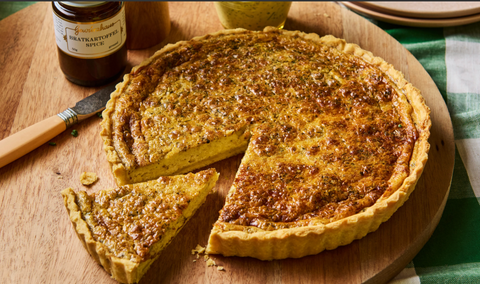
Regular price

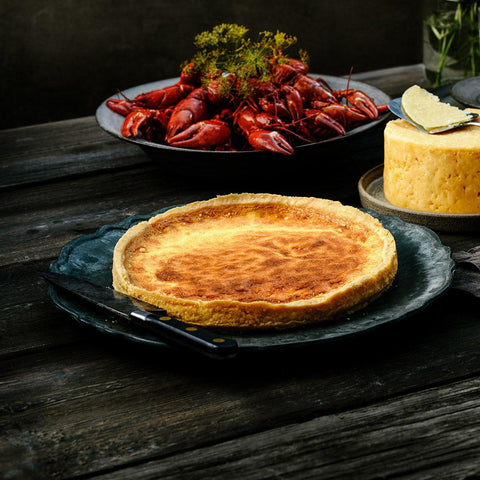
The Pie That Tastes Like Home
You know the evening, even if you haven't had one in years.
It is late August and the light has gone soft and low. Paper lanterns are strung between the trees, glowing red and yellow, and somebody has hung one slightly crooked and nobody has fixed it. There are silly hats. There is a songbook with a broken spine that comes out every single year, and a round of Helan går sung with more enthusiasm than accuracy. Your fingers smell of dill and brine and you have given up on the small fork entirely. Someone at the far end of the table is explaining, at length, the correct way to open a crayfish, and everyone is ignoring them.
And then the kitchen door opens and the pie comes out.
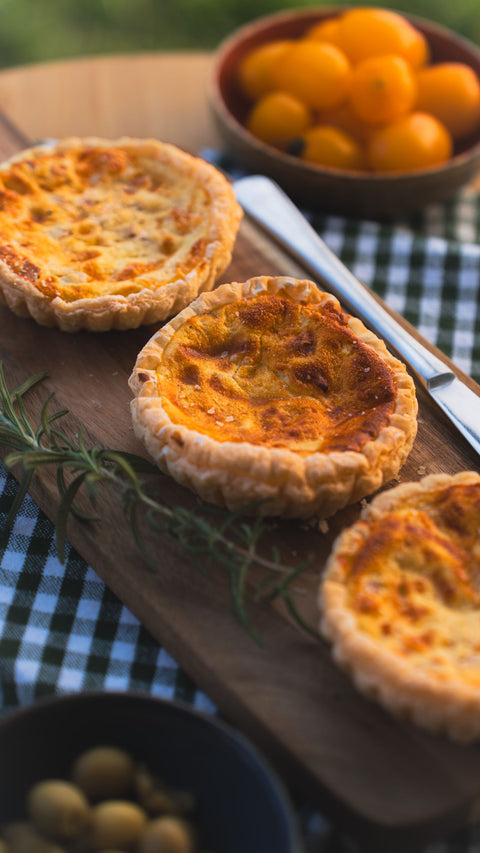
Still ticking with heat. Deep gold on top, the smell arriving before the plate does sharp, nutty, almost salty-sweet. And the table goes quiet for a second, the way it always does, before the noise starts again.
Then you moved abroad. And August came around anyway.
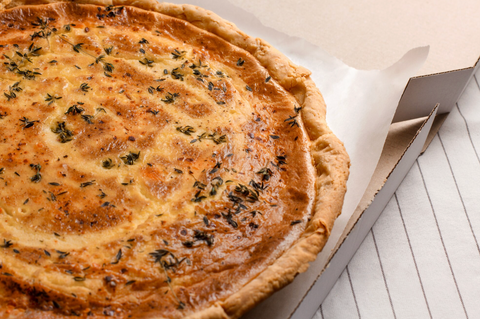
Crayfish season is upon us. The old fishing ban that once ran until early August was lifted back in 1994, but nobody told the tradition Swedes still gather in the first half of August, and in 2026 the traditional premiere falls on Saturday the 8th, with the following weekend running a close second for parties.
If you are hosting one this year, wherever in the world you have ended up, here is the good news: the crayfish are the easy part. The pie is the part people remember. And unlike almost everything else on that table, the pie is entirely within your control.
It just requires the right cheese. Which brings us to a small village in northern Sweden.
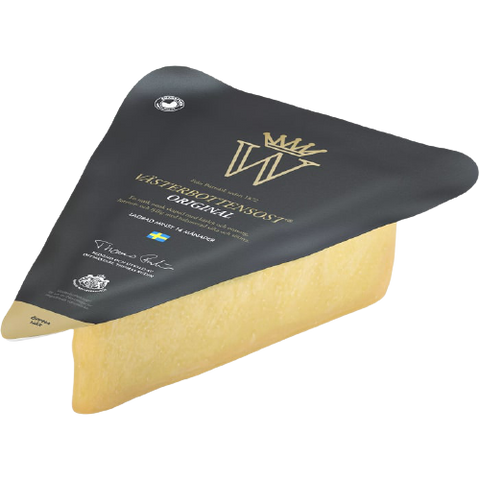
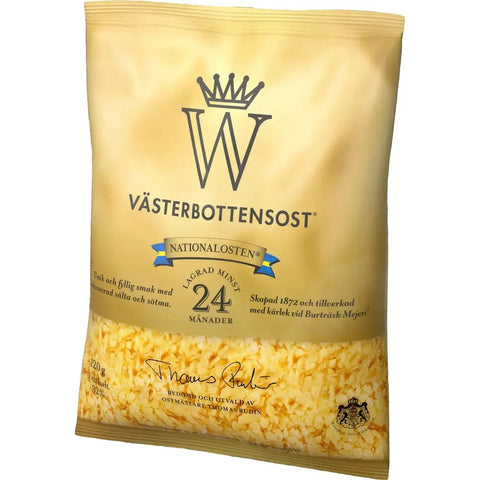
Here is a fact that should be better known than it is: today, Västerbottensost is made in exactly one place on earth.
The place is Burträsk, a village in Västerbotten with a few thousand inhabitants, a long winter, and a dairy. The year was 1872. The person was a dairymaid named Ulrika Eleonora Lindström.
Her story deserves telling properly, because it is better than most origin myths. She was born in 1835 outside Burträsk into a large, poor family, and was given up for adoption to a childless couple as a small child. When her adoptive father died, she inherited 500 riksdaler a serious sum at the time, and a life-changing one for a young woman working as a housemaid. She could have kept it. Instead she spent every öre of it on an education, travelling all the way south to the dairy school at Degeberg in Västergötland to learn the craft properly.
She came back north in 1869 and took work at the newly founded Gammelbyn dairy in Burträsk. She started as a maid. Three years later she was running the place as head dairymaid. And in 1872, something happened at the cheese vat.
What she arrived at was a method of repeated heatings with continuous stirring unusual, difficult, and still the method used today. What happened at the vat that particular day is a story we will come back to at the end of this article, because the version everybody tells is almost certainly wrong, and the truth is better.
It did not stay a Burträsk secret for long. By the early 1900s the cheese was being made at dairies all over Västerbotten, and the quality was wildly uneven which is precisely why, in 1910, a far-sighted man named Johan Bexelius registered a trademark for it. The W with a crown above it has stood for the real thing ever since. Production consolidated over the following decades, and today the cheese comes from Burträsk alone.
Then it waits. A minimum of fourteen months, and often longer. Days in press, days in brine, weeks of rest before the first waxing. Fourteen months is not a production schedule; it is an act of faith. Somebody made the wheel you are about to grate before you had made most of this year's plans.
That patience is what you can taste. The deep savoury weight of it. The faint sweetness underneath. And those little white crystals that crunch between your teeth the signature of a cheese that has been left alone long enough to become itself.
Nobody is entirely certain why it cannot be made anywhere else. The theories are wonderful, and two of them are in the list below.
Here is the charming part, and the thing that surprises almost everyone: the pie is not ancient. Not remotely.
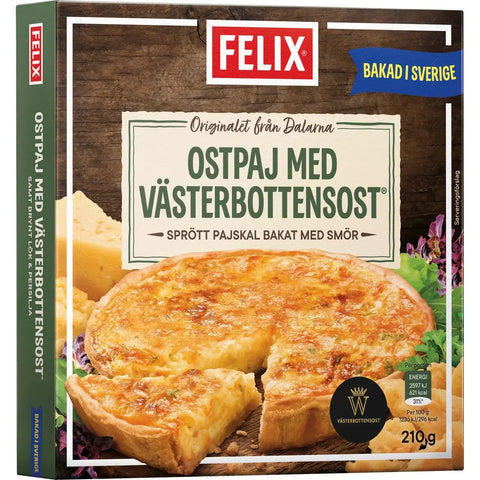
Sweden has been eating crayfish since at least the 1500s and holding proper crayfish parties since the early 1900s. But the Västerbottensost pie is a genuinely modern invention. It appeared, most likely, at the very end of the 1980s or the start of the 1990s, and turns up in the Swedish press for the first time in 1994. It then conquered the Swedish August table in roughly a decade.
Which means there are people alive today quite a lot of them who clearly remember a time before it existed. Ask an older relative. They will probably remember the first one they ever ate, and the kitchen it came out of.
Why did it win so completely? Because it is the perfect counterweight. Crayfish are cold, sweet, herbal, eaten with your hands in small fiddly amounts, and let us be honest not especially filling. The pie arrives warm, rich, deeply savoury, and substantial enough to hold a long evening together through several rounds of snaps. It gives the table something to do between crayfish. It is the anchor of the whole meal.
Keep score. There is a ranking at the bottom, and a bonus round for the truly unbearable.
Werner Vögeli was born in 1930 in Langnau im Emmental the cheese valley of Switzerland trained across Switzerland, Germany, Italy, Ireland and France, and arrived in Sweden in the 1950s, where he became head chef at Operakällaren in Stockholm. He was appointed royal head chef in 1972 and hovtraktör, the King's own restaurateur, in 1977. He cooked for forty-two Nobel dinners and was made an honorary doctor at Umeå University.
He is also the man credited with bringing Västerbottensost to the Swedish royal family and carrying it out beyond Sweden's borders. A boy from Emmental, of all places, made a northern Swedish farmhouse cheese into a dish fit for kings.
Everyone assumes it is ancient, handed down through Norrland generations. It isn't. It most likely dates from the late 1980s or early 1990s and first appears in Swedish newspapers in 1994. It is younger than a great many of the people eating it.
The Swedish national pie is, genealogically speaking, French. Quiche Lorraine was enormously fashionable in 1980s Sweden, where it went by the name fransk ostpaj French cheese pie. Somebody swapped in the best cheese in the country, and the rest is history. Say this out loud at a crayfish party and watch the table react.
When Princess Madeleine married Chris O'Neill at Drottningholm Palace on 8 June 2013, the wedding dinner began with Västerbottensost pie served with primeur eggs from Gotland and a caviar foam. Not the cheese. The pie. The same dish you are about to make in your own kitchen, several hundred kilometres from Sweden.
It has form at the other great Swedish dinner, too: at the Nobel banquet in 2000, the main course was lemon-fried duck breast with a Västerbotten timbale, a chanterelle and Jerusalem artichoke ragù and herb potato purée.
In the poem cycle Trefaldighetsnatten, from his collection Ordalek och småkonst, August Strindberg has a customs officer throw open the windows on the first evening of spring and order supper for seven: aquavit on ice, crayfish and eel, new radishes, the tenderest crispbread and, he insists, don't forget the Burträsk cheese. He calls the result a feast laid in the proper Swedish manner.
Strindberg is said to have loved the cheese, and to have considered it a matter of course alongside crayfish. Which means the greatest writer in Swedish literature had already worked out the pairing generations before anyone thought to put it in a pastry shell.
Not marketing language. The method Ulrika Eleonora worked out in 1872 has never been published. It is known to a small handful of people and passed from cheesemaster to cheesemaster across generations. More than 150 years, and it has never leaked.
This is the fact that will win you an argument. A great many Swedish websites confidently state that Västerbottensost carries EU protected-origin status like Champagne or Parmigiano-Reggiano. It does not. It is protected as a trademark Bexelius's W mark, registered in 1910 and Norrmejerier alone may sell cheese under the name. It has sat on the list of Swedish candidates for a future application for years. Kalix löjrom, the roe you put on top of the pie, genuinely does hold protected designation of origin. The cheese doesn't.
Burträsk sits near the site of an ancient meteorite impact, and one long-standing theory holds that the strike left the soil unusually rich in lime. The cows graze on it, the minerals travel into the milk, and the milk becomes the cheese. Whether or not it is the true explanation, it is an extremely good story about a pie.
The other theory is the house flora the invisible community of microorganisms that has lived in the walls of that specific building for a century and a half. When the Burträsk dairy was expanded and reopened by the King in 2014, they left an opening between the old building and the new one on purpose, so the house flora could move across into it. That is not a marketing gesture. That is a company that genuinely will not risk the thing that makes their cheese theirs.
Here is the story everybody tells: a young dairymaid, distracted by a suitor, keeps wandering away from the vat, and stumbles by pure luck into the greatest cheese in Sweden.
Here is the problem with it. The method is a sequence of repeated heatings under continuous stirring. It is genuinely difficult. It is far too complicated to arrive at by neglect you cannot forget your way into a technique like that. Swedish historians have said as much for years, and at least one has argued outright that it is time to clear Ulrika Eleonora Lindström's name.
Consider what the accident story quietly does. A woman inherits money and spends all of it travelling across the country to train as a cheesemaker. She works three years as a maid, is promoted on merit, develops a new method, and gives it to the world. And we remember her as the girl who got distracted by a boy.
She was one of the most skilled dairymaids in Sweden. The cheese in your pie is not luck. It is her craft.
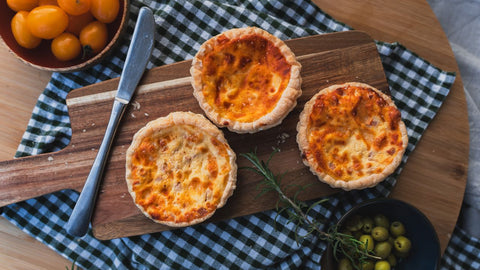
Makes one 24 cm pie enough for 8 as part of a crayfish table, or 4–6 as a proper meal.
1. Make the dough.
Work the butter into the flour and salt with your fingertips until it resembles coarse breadcrumbs. Add the water and bring it together quickly do not knead it. Wrap and rest in the fridge for 30 minutes.
2. Line the tin.
Press the dough evenly into a 24 cm pie tin, up the sides. Prick the base with a fork. Chill again for 15 minutes; this is what stops it shrinking.
3. Blind bake.
Bake at 200°C conventional (180°C fan). Line the shell with baking paper and baking weights and bake for 12 minutes. Remove the paper and weights, brush the entire inside with beaten egg, and return it to the oven for another 3 minutes until the egg has set into a seal.
4. Make the filling.
Whisk the eggs and cream together. Stir in the grated cheese and a generous grind of white pepper. Do not add salt.
5. Bake.
Pour the filling into the shell. Bake at 175°C conventional (155°C fan) for 25–30 minutes, until golden and puffed around the edges but still slightly trembling in the centre.
6. Rest.
Leave the pie to rest for at least 15 minutes before slicing.
This is where pies are won.
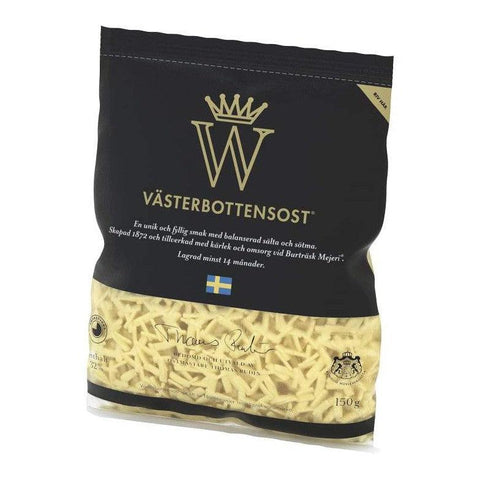
The single most common mistake. Finely grated cheese melts too quickly and releases its fat before the custard has set, leaving an oily surface. Use the large holes on your grater and trust the cheese to melt properly.
A pale, underbaked crust absorbs the filling and becomes soggy. Bake it until it develops real colour, then brush it with beaten egg and return it to the oven for a few more minutes. That thin cooked layer of egg creates a waterproof barrier between the pastry and the filling.
Three eggs, 2 dl cream and 300 g cheese.
More egg makes the filling firm and rubbery. More cream prevents it from setting properly. Custards rely on balance.
Ever.
A cheese aged for fourteen months already contains all the salt the pie needs. White pepper is the only seasoning required, and only in moderation.
The centre should gently wobble like a set panna cotta when you nudge the tin. It will continue cooking after it leaves the oven. Waiting until it's completely firm guarantees an overcooked, dry pie.
Always wait fifteen minutes before cutting.
Slice it immediately and the filling will spread across the plate instead of holding a beautiful wedge. It's the hardest rule to follow and one of the most important.
A plain Västerbottensost pie is excellent.
A crowned one becomes an occasion.
Top each warm slice with a spoonful of crème fraîche, a generous spoonful of löjrom, and finely chopped red onion.
This combination is considered the canonical version for good reason. The cold, salty roe against the warm, rich pie is one of Swedish cuisine's greatest flavour pairings. If you're serving the pie as part of a crayfish party, this is the version to make.
It is also, more or less, the way it was served at Princess Madeleine's wedding banquet.
Keep these as variationsbnot replacements. The classic recipe has earned its reputation.